






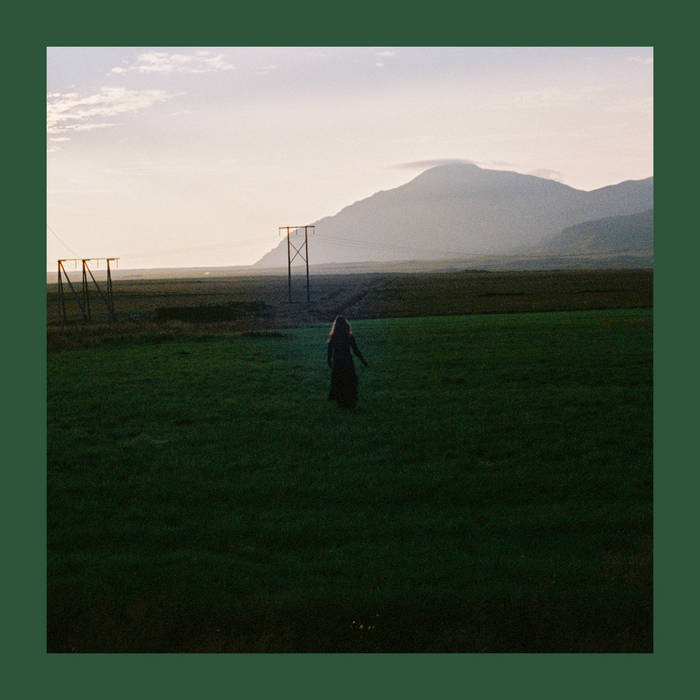
Ásgeir has long been lauded for his intricate folk-pop, lush production, and wistful, emotive falsetto. ‘Julia’ marks a shift toward not just lyrical self-reliance but cathartic directness, songs that feel not just exquisitely performed, but lived in. “This was kind of the first time I was writing lyrics totally on my own,” he shares. “It was scary. I’m still trying to find myself within that. But I tried to open myself up and I learned a lot through that process, and it was definitely therapeutic for me.”
This new sense of vulnerability threads through the album’s ten tracks, written and recorded over the course of nearly two years. Many of the songs were first composed on guitar, with Ásgeir aiming for simplicity, prioritising melody, clarity, and meaning. The production, co-developed with longtime collaborator Guðm. “Kiddi” Kristinn Jónsson, remains organic and understated, allowing Ásgeir’s voice, and importantly his voice as a writer, to come forward.
Throughout ‘Julia’, Ásgeir revisits the past with an unflinching eye. ‘Quiet Life’ is a warm, thoughtful invitation into Ásgeir’s world of self-reflection. It sets the tone for an album that is spacious, seamless, and earnest. The production is subtle yet expansive, drawing on earthy textures that support the album’s introspective mood.
On ‘Against the Current’, Ásgeir captures the quiet defiance of self-reclamation. Written and recorded almost entirely by himself, with a brass arrangement from Samuel Jón Samúelsson, the track builds into a triumphant swell. Lyrically, it is about finally seeing oneself clearly, shaking expectations and embracing the possibility of change. “The lyrics paint a picture of me seeing myself really for the first time. Seeing that I’ve been stuck in my ways, letting other people’s opinions of me change who I am and wanting to break from that pattern. To not let anyone, including myself, put me in a box and not limit my potential through what ideas someone might have of me. Realising that there’s many versions of me that need to shine as well. I could start a black metal band tomorrow if I wanted to.”
‘Smoke’ was recorded live with a four-piece band and later overlaid with pump organ. The track revolves around “feeling like you’ve lost your inner voice. Some years ago, I felt like I ignored it so much that in the end it faded away, both in terms of music and life, and it felt terrible. I felt like I had gone against it so much that it stopped speaking to me. In a way I’ve always felt like that’s a feminine, motherly voice that leads you in the right direction.” That maternal influence is a recurring theme across the LP, and, in many ways, ‘Julia’ is a concept that has come to embody Ásgeir’s personal journey. Here, production is minimal, letting the melancholy shine through, the ache of disconnect.
Elsewhere, the album turns toward the future. ‘Ferris Wheel’ is an anthem of quiet optimism, born from conversations with his girlfriend about abandoning the familiar and pursuing long-held dreams, of a slower life by the sea, of daring to imagine something new. “It’s about dreaming again,” he says. “Something I had stopped allowing myself to do.”
|
“Sweeping and emotive” – NME “Widescreen and dramatic” – Brooklyn Vegan “A mixture of reminiscence, wonder, heartache, clarity” – Atwood |
Nashville’s Nathaniel Smith, a cellist Ásgeir describes as “a wizard”, adds atmospheric bedding here and throughout, improvising melodies that give life and dimension to tracks in ways Ásgeir hadn’t previously envisioned.
‘Universe Beyond’ is a tragedy that imagines the final thoughts of our protagonist Julia before she walks into a lake, the prelude to the macabre tale that unfolds on the album’s title track. ‘Julia’, the album’s emotional centrepiece, draws from a chilling Icelandic poem. A ghost story wrapped in eerie pedal steel, as a heartbroken woman returns from the dead to reunite with her former lover, forever. It is cinematic in scope but intimate in tone, blurring the line between myth and memory.
Rhythmically restless, ‘Sugar Clouds’ is built in an unusual 7/8 time signature that mirrors the tension of its theme, a yearning for fulfilment and inner peace. “I don’t think I’ve ever truly felt that sense of being satisfied,” Ásgeir admits. “But this song imagines what it might feel like.”
‘Stranger’ explores the feeling of becoming unknown to oneself, a consistent undercurrent of the record. The track drifts gently in mood, evoking distance and subtle transformation, as if awakening in a life that feels unfamiliar, but not necessarily unwelcome.
‘In the Wee Hours’ is a reckoning with the version of yourself that used to live for the night. It captures the moment when the appeal of late-night bars and blurred conversations begins to wear thin. It is a vivid realisation that some parts of life no longer fit, a song about ageing out of recklessness, watching the clock tick into morning, and wondering whether anything meaningful really happens after that.
The album closes with ‘Into the Sun’, a hopeful coda and release. After moving through doubts and regrets, the final track emerges into light. There is a sense of acceptance here, not of perfection, but of the self in all its complexity.
These recordings mirror the spirit of Ásgeir’s recent return to solo touring, over 70 shows across Europe, the Nordics and Iceland, often in small churches or quiet venues. Those performances reconnected him with the core of his music; storytelling, presence and shared stillness. Musically, the record leans into Ásgeir’s long-held love of folk and Americana. He cites influences ranging from Daniel Lanois, Leonard Cohen, and Nick Drake to contemporary artists like Adrianne Lenker, Dina Ögon, Gregory Alan Isakov, and Saya Gray.
Ásgeir is one of Iceland’s most successful exports. His debut album, ‘Dýrð í dauðaþögn’, became the best-selling debut in Icelandic history, leading to the English-language version ‘In the Silence’ in 2014. He continued to refine his sound with ‘Afterglow’ in 2017, ‘Bury the Moon’ in 2020 and ‘Time on My Hands’ in 2022, earning praise from press and radio worldwide, including the likes of The Independent, MOJO, NME, The Line of Best Fit, Clash Magazine, BBC 6 Music and Radio X.
In recent years, he also performed with the Icelandic Symphony Orchestra and recorded a live session for Arte TV in Berlin. He wrote a song for a Kafkaesque play that was hosted at the Reykjavik City Theatre called Sýslumaður Dauðans.
In ‘Julia’, Ásgeir doesn’t just look back, he carries these memories forward, reshaping them. These songs live in the space between reflection and reinvention, where the past softens, and the future’s horizon comes into focus.
Music credits
- Recorded in Studio Hljóðriti & Stúdíó Sýrland, Iceland
- Engineered by Ásgeir Trausti Einarsson, Guðmundur Kristinn Jónsson & Gestur Sveinsson
- Mixed by Ásgeir Trausti Einarsson, Guðmundur Kristinn Jónsson & Gestur Sveinsson
- Mastered by Calbi / Fallone at Sterling Sound
- Produced by Ásgeir Trausti Einarsson and Guðmundur Kristinn Jónsson
For all press enquiries please contact Stefan.Hayes@v2benelux.com
 |
[Back to TOP] |
Geen opmerkingen:
Een reactie posten