
Grammy winner, Rock & Roll Hall of Famer, and Songwriters Hall of Famer John Fogerty is a towering figure in American music. As the leader of Creedence Clearwater Revival and as a solo artist, Fogerty forged an entirely distinctive sound—equal parts blues, country, pop, rockabilly, R&B, swamp boogie, and Southern fried rock & roll—alongside powerful, resonant lyrics, true workingman’s poetry.
His classic songs, including “Proud Mary,” “Fortunate Son,” “Born on the Bayou,” “Bad Moon Rising,” and “Have You Ever Seen the Rain,” have sold over 100 million copies. His 1997 Blue Moon Swamp won the Grammy for Best Rock Album, and his solo work has been nominated for a total of 8 Grammys over the years. He’s even the only musician to be inducted into the Baseball Hall of Fame for his song “Centerfield,” a staple at ballparks across the country.
So Fogerty’s status as a legend has long been secure. What’s more remarkable, though, is how popular and influential his music remains after more than 50 years.
Recently, Rolling Stone ran a story with the headline “The Biggest Band in America in 2024 is…Creedence Clearwater Revival.” John Fogerty and his monumental collection of CCR hits on Chronicle: The 20 Greatest Hits has spent 746 weeks and counting—more than 14 consecutive years—on the Billboard 200 album chart.
In 2025, Fogerty has continued this momentum with a series of high-profile appearances, including a keynote speech at SXSW, induction by Bruce Springsteen at the American Music Honors for his influence on American music, and fiery headline sets at JazzFest, Glastonbury, and the Hollywood Bowl. All this in the year which also sees him celebrating his 80th birthday.
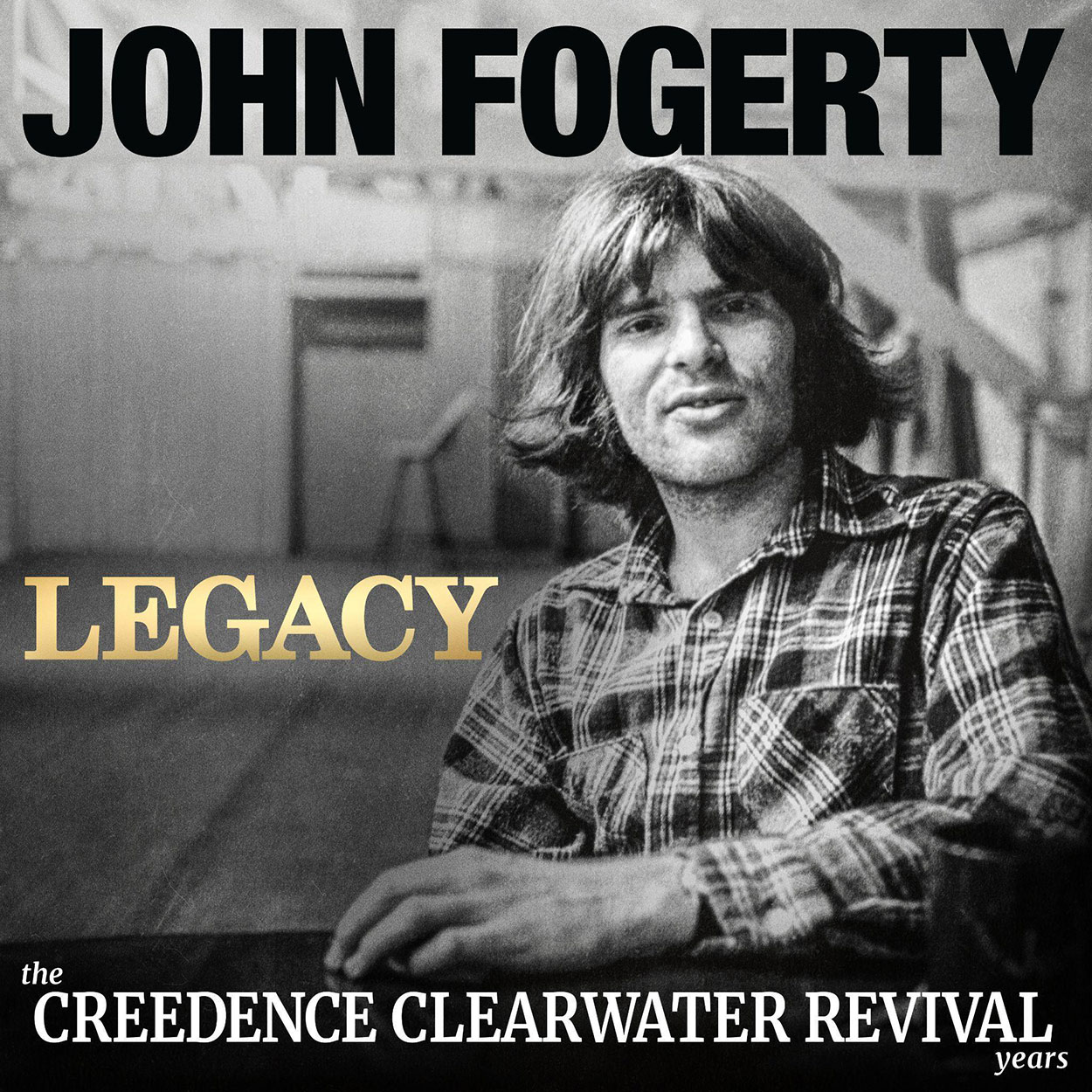
This milestone is also being marked with the release of Legacy: The Creedence Clearwater Revival Years, an album which includes newly re-recorded renditions of 20 of Fogerty’s most beloved songs. Inspiration for this project began in 2023, after Fogerty fulfilled a longtime personal mission when, after a series of lawsuits, he acquired a majority interest of the worldwide publishing rights to his song catalog from Concord Records. But his wife, Julie, realized that the rights to the recordings themselves would never revert to him, and began floating the idea of cutting new versions backed by his family band.
“For many years, I had a struggle with the music business, the companies that I had been signed to way back when I was a kid,” says Fogerty. “I was always proud of the songs I wrote, but I had to do this weird mental separation between owning them and being the spiritual owner. Now that that was removed, my relationship to it all became different and it became really a nice feeling, especially working with my family.”
Rather than reinterpret his CCR-era masterpieces, he opted to recreate the originals as closely as possible. “There's a zillion things you could do—Americana or folk rock or acoustic,” he says. “But that just seemed to me like a tangent that maybe people wouldn't want. Either you're going to be way different, or you're going to try your best to sound exactly the same. And that was kind of a cool challenge. I'm competitive and maybe a little bull-headed, so it became the mission—at times blissful and sublime, and other times a really hard task.”
Recording this material wasn’t just a matter of dropping in and singing songs he’s performed many hundreds of times; it required getting back into the mindset he had when he originally went into the studio, and precise study of his guitar parts. “My son Shane would help me,” Fogerty says. “He'd be listening and learning himself and he’d say, ‘Dad, there's way more going on in this part.’ I'd go, ‘Oh my goodness, listen to that!’ and then I had to relearn a much more technical way of playing. I had 50 years of bad habits—playing the easy way so that I could sing at the same time.”
The Legacy album is the latest result of a steady output in recent years. During the 2020 quarantine, the Fogerty Family—featuring John with his sons Shane and Tyler and his daughter Kelsy—started a weekly video series from their home studio called “Fogerty’s Factory,” which became so popular that they documented it with an album. In 2021, Fogerty released his first new original solo music in eight years, “Weeping in The Promised Land,” a moving tribute to those who had been affected by the pandemic, as well as those who have suffered through prejudice and injustice.
Gaining the rights to his publishing was the fulfillment of a lengthy crusade. For years, the copyrights to Fogerty’s songs were the property of Saul Zanetz, the owner of Fantasy Records. The conflicts Fogerty had with the label became the subject of multiple lawsuits; first, he won a case that Fantasy brought against him for copyright infringement and then, when he was held liable for his attorneys’ fees, he countersued and in a groundbreaking 1994 decision, the United States Supreme Court ruled that it was unfair for successful defendants to face a higher burden than successful plaintiffs. Both verdicts represented hard-fought victories for the rights of artists everywhere.
Zanetz sold the label and its publishing portfolio to the former Concord Music Group in 1995. Fogerty, who had extricated himself from Fantasy in 1974, re-signed with the label upon its purchase by Concord but he was still not able to gain ownership of his songs until this deal was completed.
“They had the product of my work, my voice and my songs, so I was treated like a non-entity,” he says. “A lot of times, my music was used in ways I disagreed with, and I had no say in the matter. It was a heartbreaking feeling.
“The day that we got it signed was a big celebration, but you don't really know exactly what it means. For these past couple years, though, we've lived a different life. They can't just go do stuff and we don't like it. They have to ask us now. We've taken that on in such a profound way and boy, it sure feels great. For most of my life I did not own the songs I had written. Getting them back changes everything. I will celebrate this for the rest of my life.”
(He points out that Legacy is coming out on Concord, the same label that also has the Creedence recordings—"that tells you, right there, that something right must be happening.”)
Soon after acquiring ownership of his catalog, Fogerty took to the road on the 2024 “Celebration” tour, playing almost fifty dates including storied venues like Red Rocks and Bethel Woods (the site of Woodstock) and a residency in Las Vegas. Reviews described the show as a “high energy rock ‘n’ roll party” and noted that “Fogerty’s enthusiasm and happiness were infectious.”
It's been an amazing journey for John Fogerty—a working-class kid from the Bay Area suburbs who fell in love with rock & roll and dreamed of a mythic America. One of the few rock stars drafted in the Vietnam era, he put in his time with the Army, gathered his band, and fought his way up through the local bar scene.
“At the end of 1968,” he says, “I took stock of my position and looked at the fact that we had one hit. We could forever be a one-hit wonder. We didn’t have a manager or an agent, we just had a teeny, tiny record label that was mostly a jazz label, and I realized I’d just have to do it with music.”
Between 1969 and 1971, CCR went on a historic hot streak, releasing fourteen consecutive Top 10 singles and five consecutive Top 10 albums, two of which—Green River and Cosmo’s Factory—went to Number One. Decades later, Fogerty remains a paragon of songwriting, a voice of protest, and a beacon of integrity.
Digging so deeply into the Creedence recordings for the Legacy project has meant coming full circle for John Fogerty, and he found the process enlightening and cleansing. “There's been a lot of controversy and struggle over the years involving my music,” he says. “Coming to grips with how great these records are and getting to redo them, getting them to live up to that standard that I had set for myself all those years ago, has been really good for me. It let me have a relationship with the music that's purely based on the goodness of the music and not worrying about all the other stuff that got attached later.
“I'm 80 years old,” he says. “I'm giving myself a gift with this album, and I'm giving my fans a gift at the same time.”
For more information contact Stefan.Hayes@V2Benelux.com
Geen opmerkingen:
Een reactie posten